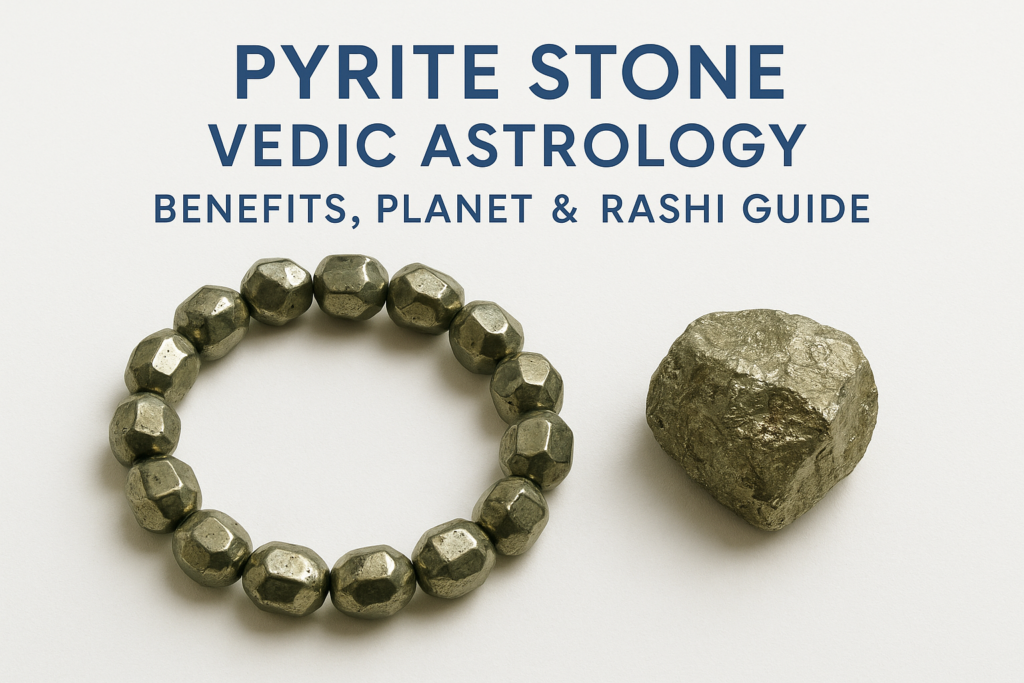
Pyrite has held a firm place in spiritual traditions for centuries, but its role in pyrite stone Vedic astrology is something most Western gem guides overlook entirely. In Jyotish, the ancient Indian science of light and celestial influence, every gemstone carries a specific planetary vibration. Pyrite, with its metallic luster and iron-rich composition, connects to some of the most powerful grahas (planets) in a birth chart, particularly those tied to wealth, willpower, and material achievement.
If you’ve landed here, you probably want straight answers: Which planet does pyrite represent? Is it safe for your rashi (zodiac sign)? Can it actually attract prosperity, or is that just social media noise? This guide breaks down pyrite’s Vedic associations, including its links to the Sun, Saturn (Shani), and Mars, and explains which birth chart placements benefit from wearing it and which ones should avoid it. No vague promises, just practical astrological guidance backed by classical Jyotish principles.
At Natural Pyrite UAE, we work exclusively with 100% natural, dark-gray pyrite, the authentic mineral, not the gold-painted imitations flooding online marketplaces. Every bracelet and decorative piece we handcraft is built for people who take both aesthetics and intention seriously. Whether you wear pyrite as a Vedic remedy or as a daily symbol of focus, knowing its astrological profile helps you make a more informed choice. Let’s get into it.
What pyrite means in Vedic astrology
Jyotish, or Vedic astrology, treats gemstones as planetary transmitters, physical objects that absorb and amplify the energy of specific celestial bodies. When you wear a stone with the right planetary alignment for your birth chart, Jyotish holds that the stone strengthens that planet’s positive influence in your life. Pyrite stone Vedic astrology sits in a specific, often misunderstood category within this system. It isn’t a traditional Navaratna gem (the nine primary planetary stones), but that doesn’t reduce its relevance. In classical Jyotish texts, gemstones beyond the primary nine are called uparatnas, or secondary stones, and they carry real remedial weight for practitioners who understand how to apply them correctly.
How Jyotish classifies gemstones
Jyotish divides gemstones into two tiers: primary (mukhya) and secondary (uparatna). Primary stones include ruby for the Sun, pearl for the Moon, red coral for Mars, emerald for Mercury, yellow sapphire for Jupiter, diamond for Venus, blue sapphire for Saturn, hessonite garnet for Rahu, and cat’s eye for Ketu. These are the reference points in Vedic gem therapy. Secondary stones serve the same planets but operate at a gentler, often more accessible vibrational level. Pyrite belongs firmly in the uparatna category, functioning as a substitute stone connected to Mars and the Sun, with secondary associations to Saturn in some regional Jyotish schools. For many people, a secondary stone is actually the more appropriate prescription, since the full intensity of a primary stone can overload a birth chart that isn’t positioned to handle it.
Secondary stones aren’t a consolation prize in Jyotish. For many practitioners, they’re a safer starting point, especially when a primary stone’s intensity could overwhelm a sensitive birth chart configuration.
Pyrite’s elemental and material profile in Jyotish
Vedic astrology classifies minerals not just by color or rarity but by their elemental composition and energetic signature. Pyrite, iron disulfide by chemical structure, carries a strong agni (fire) and prithvi (earth) element combination. Fire connects directly to the Sun and Mars, both planets linked to ambition, leadership, and decisive action. Earth grounds that fire energy, stabilizing it so the influence translates into practical, measurable results rather than raw impulse with no direction. This dual elemental profile explains why Jyotish practitioners who work with uparatnas often recommend pyrite specifically for clients whose charts show a weakened Sun or Mars placement. The stone doesn’t just carry symbolic meaning in this framework. It acts as a physical anchor for planetary energy that your chart already needs but isn’t receiving in full.
What pyrite represents symbolically in a birth chart
Beyond elemental classification, pyrite carries a specific symbolic function within Jyotish’s interpretive language. Its highly reflective metallic surface connects it to solar energy and the outward projection of power, confidence, and visible authority. In astrological terms, this maps onto the 1st house (self and identity), the 10th house (career and public standing), and the 11th house (income and material gains), which are the houses most practitioners target when recommending pyrite as a remedial tool. Your birth chart may show weakness in these houses due to an afflicted Sun, Mars, or Saturn. In those cases, pyrite works as a corrective instrument, reinforcing the planetary vibration your chart needs to move forward with clarity, focus, and material momentum.
Which planet connects with pyrite
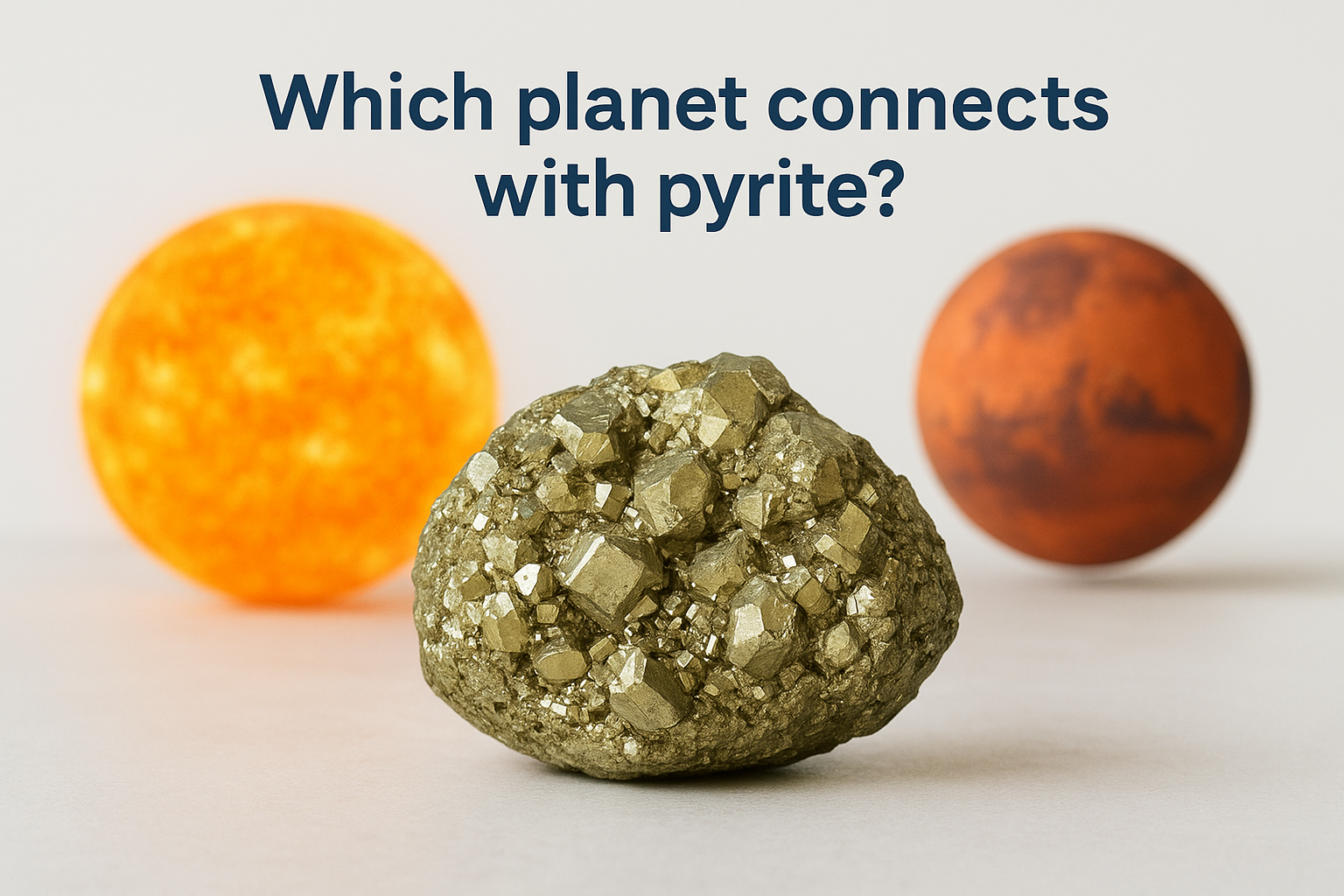
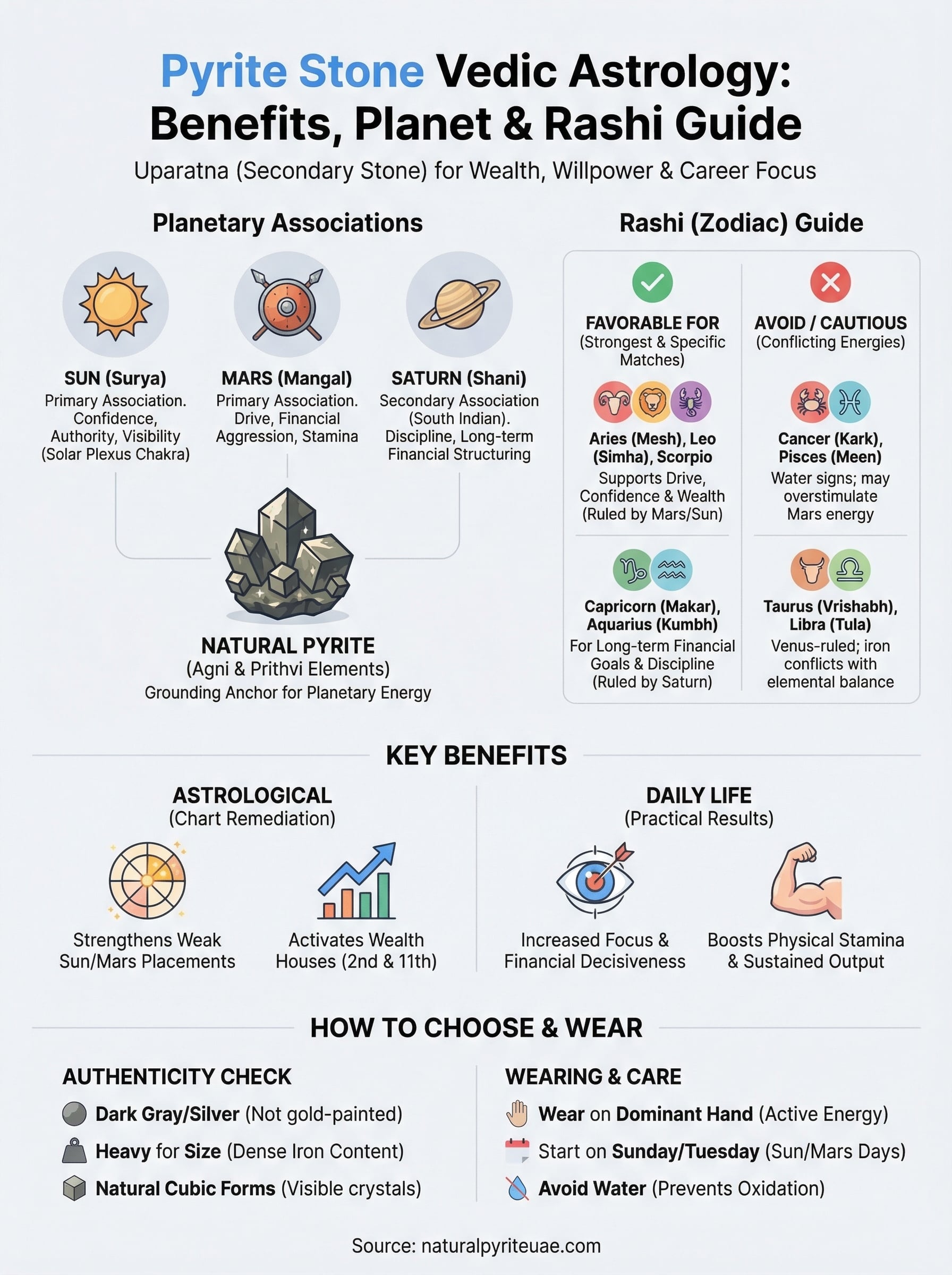
Pyrite doesn’t belong to a single planet in Jyotish the way ruby belongs exclusively to the Sun. Most classical practitioners assign pyrite primarily to Mars (Mangal) and the Sun (Surya), with a smaller school of thought in South Indian Jyotish connecting it to Saturn (Shani) based on its iron content. Understanding these planetary associations tells you exactly what wearing pyrite does to your birth chart’s energy.
The Sun and Mars: pyrite’s primary planets
The Sun rules self-confidence, authority, and visible leadership, and pyrite’s metallic reflective surface is the clearest physical expression of Surya’s energy in the mineral world. When your Sun sits weakened in your natal chart, either by difficult house placement or aspects from malefic planets, you may notice low self-worth, poor professional recognition, or an inability to project authority in competitive spaces. Pyrite stone Vedic astrology practitioners recommend it as a solar amplifier for clients who need Surya’s clarity without the full intensity of a ruby prescription.
Mars governs drive, financial aggression, and physical stamina, and pyrite’s iron-disulfide composition makes it a direct material carrier of Mangal’s frequency. Red coral is the primary Martian stone, but pyrite is the most widely used uparatna substitute when a birth chart calls for a gentler Martian push. If your Mars rules the 2nd house (accumulated wealth) or the 11th house (income and gains) in your chart, wearing pyrite consistently can activate the forward momentum needed to break through financial plateaus.
When both your Sun and Mars carry weak placements in the same natal chart, pyrite gives you a single stone that addresses both simultaneously, which is rare for any uparatna.
Saturn’s contested connection
South Indian Jyotish schools link pyrite to Shani (Saturn) based on iron’s classical association with the planet in traditional planetary metal systems. This connection isn’t universally accepted across all Jyotish lineages, but it carries a specific remedial logic that many experienced practitioners apply with consistent results. When Saturn rules your wealth-producing houses, such as the 2nd or the 11th, some practitioners recommend pairing pyrite with a primary Shani stone for a grounded, dual-planet approach.
This association also explains why pyrite suits people navigating long-term financial restructuring rather than quick windfalls. Saturn rewards sustained effort and discipline, which aligns naturally with pyrite’s earthy, stabilizing elemental profile in Jyotish classification.
Pyrite benefits in astrology and daily life
Pyrite delivers benefits on two distinct levels in Jyotish: astrological remediation and tangible daily-life results that you can observe without any prior knowledge of planetary charts. These two levels aren’t separate in Vedic thinking. When you correct a planetary imbalance in your birth chart, the correction shows up in your practical reality, in the deals you close, the confidence you project, and the consistency of your financial decisions. That’s the core logic behind pyrite stone Vedic astrology as a remedial practice, and it’s why the stone carries weight beyond surface-level crystal spirituality.
Astrological benefits: what pyrite activates in your chart
Pyrite’s strongest astrological function is strengthening weakened Sun and Mars placements in your natal chart. A debilitated or afflicted Sun often shows up as poor professional recognition, lack of self-authority, and difficulty holding positions of leadership. A weak Mars can drain your financial drive and reduce your ability to act decisively when opportunities appear. Wearing pyrite as an uparatna remedy works to stabilize and amplify the planetary frequency your chart is underutilizing, giving those placements a consistent external signal to draw from.
Pyrite doesn’t override your birth chart. It reinforces the planetary potential already present in your configuration, so the quality of your natal placements determines how strongly you’ll feel the effect.
Beyond Sun and Mars, practitioners who follow South Indian Jyotish lineages also use pyrite to support Saturn-ruled house activations, particularly when Shani governs the 2nd or 11th house in a chart. In those configurations, pyrite acts as a grounding agent that translates Shani’s slow-building energy into visible, cumulative wealth accumulation over time.
Daily life benefits: what changes when you wear pyrite consistently
On a practical level, pyrite’s most commonly reported benefit is a measurable increase in focus and financial decisiveness. People who wear pyrite daily describe a sharper ability to set financial targets and move toward them without second-guessing. For executives, entrepreneurs, and real estate professionals operating in high-stakes environments, that kind of mental clarity carries direct commercial value.
Physical stamina is another consistent benefit, which aligns with Mars’s rulership over energy, drive, and physical capacity. When you wear pyrite as a bracelet during demanding work cycles, many practitioners note that the stone supports sustained output rather than short bursts followed by burnout.
Which rashi should wear pyrite
Not every rashi benefits equally from wearing pyrite. In pyrite stone Vedic astrology, your eligibility depends on which planets rule your rashi, how those planets sit in your natal chart, and which houses they govern. The broad rule is direct: if your chart needs stronger Sun, Mars, or Saturn energy, pyrite is likely a compatible stone for your sign. But rashi compatibility goes deeper than just knowing your zodiac, so the breakdown below gives you a clearer picture.
Aries, Leo, and Scorpio: the strongest matches
Aries (Mesh) and Scorpio (Vrishchik) are both ruled by Mars, which makes pyrite a natural fit for these signs. If your Mars sits in a weakened position in your natal chart, wearing pyrite as an uparatna directly supports Mangal’s energy and your drive to accumulate material wealth. The stone reinforces the qualities your rashi already inclines toward, including decisiveness, competitive sharpness, and financial initiative, but without the full intensity of a red coral prescription.
Leo (Simha) is ruled by the Sun, and pyrite aligns directly with Surya’s core frequency. For Leo natives, the stone supports visibility, leadership capacity, and professional authority, which are the defining qualities of the Simha rashi. If your Sun sits in a strong house, pyrite amplifies that placement further. If your Sun is afflicted, pyrite acts as a stabilizing supplement rather than a complete solar remedy.
For Aries, Leo, and Scorpio, pyrite is one of the few uparatnas that addresses both the wealth-producing houses and the core identity houses in a single stone.
Capricorn and Aquarius: Saturn-ruled signs with a specific case
Capricorn (Makar) and Aquarius (Kumbh) are both Saturn-ruled signs, and South Indian Jyotish practitioners frequently recommend pyrite to these rashis when Shani governs the 2nd or 11th house in the natal chart. The stone supports slow, disciplined wealth accumulation rather than rapid gains, which matches Saturn’s natural rhythm and long-horizon energy profile perfectly.
For Aquarius natives specifically, pyrite can close the gap between intellectual ambition and real-world financial results, a tension that appears regularly in Kumbh charts. Your chart may already carry strong planning ability and a long-term wealth orientation. Pyrite grounds those capacities into consistent output rather than leaving them as potential that never converts into tangible gains.
Who should avoid wearing pyrite
Some rashis and planetary configurations create a direct conflict with pyrite’s frequency. In pyrite stone Vedic astrology, the core rule is straightforward: if pyrite amplifies a planet that already dominates or overpowers your natal chart, adding more of that energy creates imbalance rather than correction. The signs and chart types below carry configurations where wearing pyrite consistently causes more disruption than benefit, and understanding this before you purchase saves you both money and frustration.
Cancer and Pisces: water signs with conflicting energy
Cancer (Kark) is ruled by the Moon, and Pisces (Meen) is ruled by Jupiter. Both planets carry a fundamentally different elemental frequency from pyrite’s fire-and-earth profile. The Moon governs emotion, intuition, and fluid energy, while Jupiter governs expansion through wisdom rather than competitive drive. When Cancer or Pisces natives wear pyrite without a specific astrological prescription from a Jyotish practitioner, the stone can amplify Mars energy in a chart that isn’t built to handle it, creating restlessness, financial impulsivity, or a friction between emotional instincts and forced decisiveness.
If your chart already carries strong Mars placements without any weakness in the Sun or Saturn houses, adding pyrite may overstimulate those placements rather than correct them.
Taurus and Libra: Venus-ruled signs and the conflict with iron
Taurus (Vrishabh) and Libra (Tula) are both ruled by Venus, and Venus carries a fundamentally antagonistic relationship with Mars and the Sun in classical Jyotish planetary hierarchy. Iron, pyrite’s core mineral component, clashes with Venusian energy at the elemental level. For these rashis, wearing pyrite without a clear remedial purpose can dull Venus’s natural strengths, including aesthetic intelligence, relational balance, and financial flow through collaborative ventures, rather than sharpening them.
Libra natives in particular need to pay close attention. Your chart often balances opposing forces already, and introducing a strongly Martian stone without a specific chart-based reason tips that balance in a direction that doesn’t serve your wealth-producing houses. If you’re a Taurus or Libra native drawn to pyrite for decorative reasons, using it as a non-worn decorative piece in your space rather than a bracelet is a safer approach that avoids direct planetary conflict.
How to choose, wear, and care for pyrite
Getting the most from pyrite stone Vedic astrology practice depends entirely on the quality of the stone you source and how consistently you maintain it. Most pyrite sold in mass-market shops is either synthetic, low-luster, or coated to mimic gold, and none of those carry the elemental profile that Jyotish practitioners work with. Natural, dark-gray pyrite with high metallic luster is the only version worth using as a Jyotish remedy, and knowing how to identify it protects you from buying something that looks right but delivers nothing.
Choosing authentic pyrite
Real pyrite is dark gray to silver-gray, not gold, and its weight relative to size is noticeably high because of its dense iron content. The surface reflects light in sharp, angular patterns rather than soft diffuse glows, and you should be able to see natural crystalline formations on at least one face of the stone. When you’re evaluating a piece for Jyotish use, check these specific markers before purchasing:
- Color: dark gray to silver-gray, never uniformly bright yellow or brass-toned
- Surface: high metallic sheen without any coating, painting, or artificial polish
- Weight: dense relative to its size, noticeably heavier than resin or glass fakes
- Structure: visible natural crystalline formations on at least one surface
The remedial value of pyrite in Jyotish depends on the stone’s natural, untreated composition. A coated imitation carries none of the elemental frequency that makes the remedy work.
Wearing and caring for your pyrite
Vedic practitioners recommend wearing pyrite as a bracelet on your dominant hand to keep it in active energetic contact throughout your working day. Start wearing a new piece on a Sunday or Tuesday morning, as those days align with the Sun and Mars respectively, which are pyrite’s primary planets. Before your first wear, rinse the stone in clean water and hold it briefly in morning sunlight to activate its solar alignment.
Caring for pyrite is straightforward once you understand its material sensitivities. Pyrite reacts to sustained moisture, so remove your bracelet before swimming, bathing, or any activity involving prolonged water contact. Wipe it down with a dry, soft cloth after any day where sweat is a factor, and store it separately from other stones to prevent surface scratching. Keep it away from enclosed humid spaces to avoid long-term oxidation that dulls the surface and weakens the stone’s structural integrity.
Key takeaways and next steps
Pyrite stone Vedic astrology gives you a clear, practical framework for working with this mineral beyond surface-level symbolism. Pyrite connects primarily to Mars and the Sun, with a secondary Saturn association in South Indian Jyotish. It suits Aries, Leo, Scorpio, Capricorn, and Aquarius most reliably, and it carries real remedial weight when your birth chart shows a weakened Sun or Mars placement. Cancer, Pisces, Taurus, and Libra natives should approach it carefully or use it as a decorative piece rather than a worn remedy.
Authenticity matters more than anything else in this practice. Only natural, dark-gray, untreated pyrite carries the elemental profile that makes the astrological remedy work. If you’re ready to source a genuine piece, browse the handcrafted natural pyrite bracelet collection at Natural Pyrite UAE, where every stone is 100% authentic and crafted for intentional daily wear in the UAE.