You found a glittering specimen at a market, inherited an old piece of jewelry, or picked up something intriguing during your travels. Now you’re staring at it, wondering if you’re holding treasure or "fool’s gold." Understanding how to tell pyrite from gold is a skill that has stumped prospectors, collectors, and curious minds for centuries. The good news: you don’t need a geology degree or expensive equipment to figure out which one you have.
At Natural Pyrite UAE, we work exclusively with authentic pyrite, sourcing, handcrafting, and delivering it across the Emirates. That hands-on experience means we know this mineral inside and out. We’ve seen the confusion firsthand and understand why people mistake one for the other. The visual similarities are real, but the physical differences are unmistakable once you know what to look for.
This guide walks you through seven straightforward tests you can perform at home using items you likely already own. From simple scratch tests to observing how light reflects off the surface, each method gives you clear, actionable answers. By the end, you’ll know exactly what that mysterious metallic specimen is, and whether it belongs in a safety deposit box or on your desk as a striking piece of natural décor.
Before you test: what you need and what to avoid
You can perform every test in this guide using household items and common tools. The setup takes less than five minutes, and you won’t need specialized equipment or chemicals. Gathering everything beforehand keeps the testing process smooth and helps you compare results accurately across multiple methods. Most importantly, preparing your workspace correctly protects both you and the specimen from damage.
Items you’ll need for testing
Your testing kit requires basic materials you likely own already. For the streak test, you need an unglazed ceramic tile (the back of a bathroom tile works perfectly). A standard steel nail or knife handles the hardness test. You’ll also want a soft cloth, a measuring cup or container for water, and a kitchen scale that measures in grams. A bright white LED flashlight helps with the visual inspection, and a small magnet (refrigerator magnets work) completes your toolkit.
The most accurate results come from testing the same specimen multiple times using different methods.
Keep a notepad nearby to record your observations. Write down what you see during each test because visual memory fades quickly, and comparing notes later reveals patterns you might miss in the moment.
Safety and handling precautions
Never perform these tests on jewelry or mounted specimens unless you’re absolutely certain you can afford to damage them. The scratch and hardness tests will leave permanent marks. If the piece has sentimental or financial value, consider taking it to a professional appraiser instead. You protect your investment and get certified results.
Work on a clean, flat surface with good lighting and ventilation. Keep children and pets away from your testing area, especially during the magnet test where small pieces could break off. Wash your hands thoroughly after handling specimens, since natural minerals can carry dust or residue that shouldn’t transfer to your face or food.
Test 1–3: look closely at color, shape, and shine
Visual inspection gives you immediate clues about what you’re holding. These first three tests require nothing more than your eyes and a bright light source. You’ll examine the specimen’s surface characteristics, structural features, and how it interacts with light. Together, these observations provide strong initial evidence before you move to physical tests.
Test 1: Compare the color under bright light
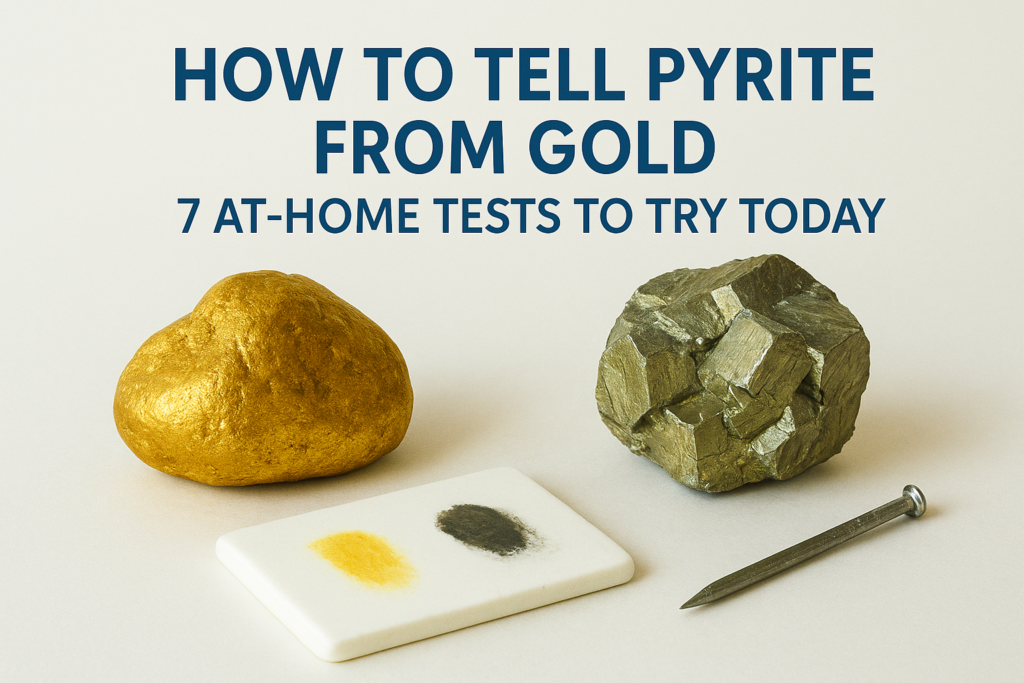
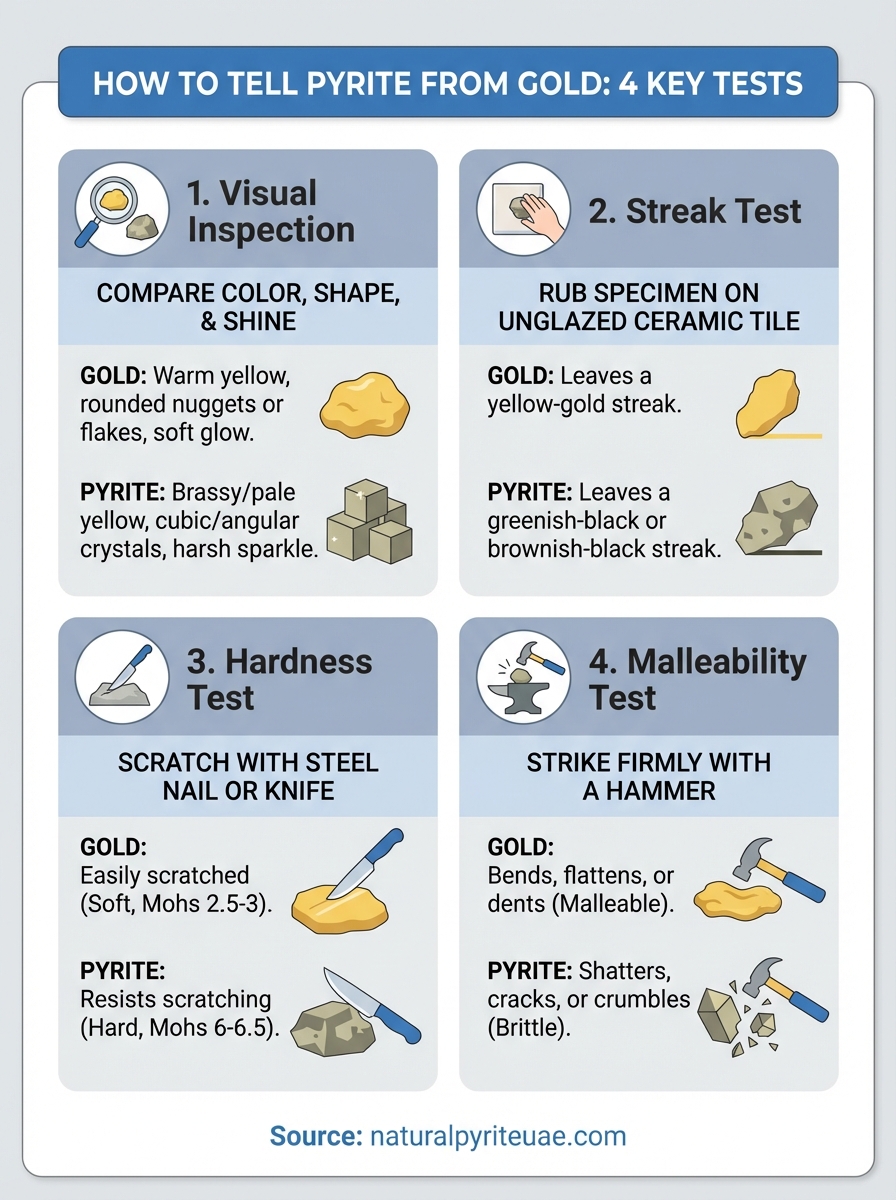
Hold your specimen under a bright white LED light and examine its true color. Real gold shows a rich, warm yellow that stays consistent across the entire surface. Pyrite displays a brassy, pale yellow with greenish or grayish undertones that become obvious under direct illumination. The difference becomes clearer when you rotate the specimen slowly, watching how the color remains uniform (gold) or shifts slightly (pyrite).
Test 2: Inspect crystal edges and structure
Look at the specimen’s shape using natural lighting or a magnifying glass. Pyrite forms cubic or pentagon-shaped crystals with sharp, angular edges and flat faces. Gold appears in rounded nuggets, flakes, or irregular masses without defined geometric patterns. If you see perfect cubes or surfaces that look like they were cut with precision, you’re holding pyrite.
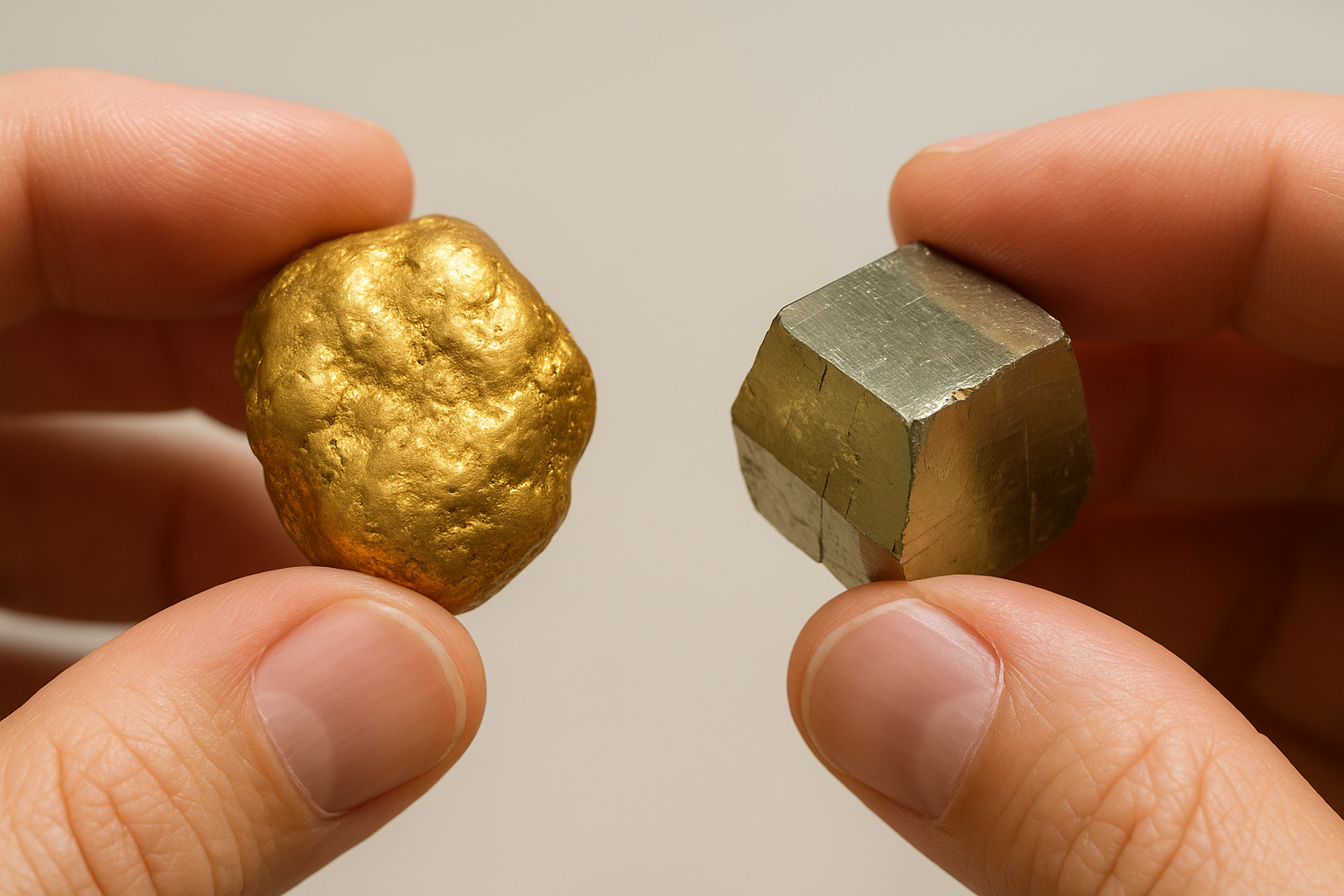
Crystal structure is one of the most reliable ways to tell pyrite from gold without touching the specimen.
Test 3: Check the surface reflection
Shine your LED light directly onto the surface and observe the reflection quality. Gold produces a soft, metallic glow that looks warm and inviting. Pyrite creates a bright, mirror-like sparkle that appears almost glittery or harsh. This sparkle comes from pyrite’s crystalline structure reflecting light in multiple directions simultaneously.
Test 4–5: do streak and hardness checks safely
These two physical tests reveal definitive differences between gold and pyrite. Unlike visual inspection, these methods produce measurable results that eliminate guesswork. You’ll physically interact with the specimen using controlled pressure and specific surfaces. Both tests cause minor surface damage, so confirm you’re willing to mark the piece before proceeding.
Test 4: Perform the streak test
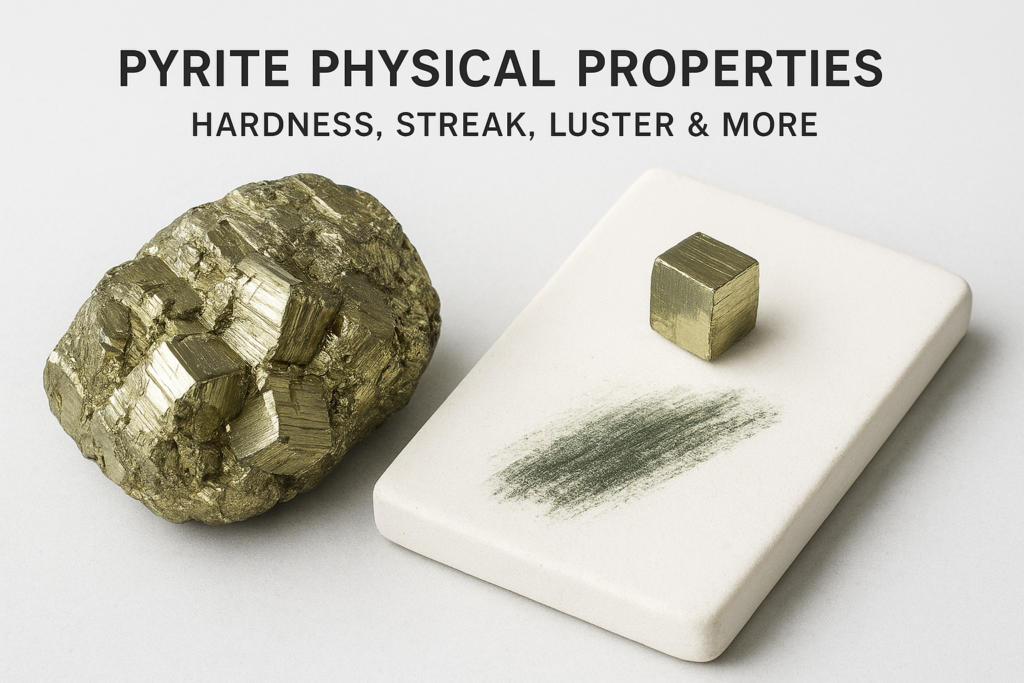
Take your unglazed ceramic tile and drag the specimen firmly across it. Apply steady pressure while moving in a straight line for about two inches. Gold leaves a yellow-gold streak that matches its body color. Pyrite produces a greenish-black or brownish-black streak that looks completely different from its brassy surface. The streak color represents the mineral’s true pigment when crushed into powder.
The streak test is one of the fastest ways to tell pyrite from gold because the results appear immediately and never lie.
Test 5: Run a controlled scratch test
Press a steel nail or knife edge against an inconspicuous area of your specimen. Apply moderate pressure and attempt to scratch the surface. Gold is soft (2.5 to 3 on Mohs scale) and scratches easily, leaving visible marks with minimal effort. Pyrite rates 6 to 6.5 on the hardness scale and resists scratching from steel. Your nail or knife slides across pyrite without leaving permanent damage.
Test 6–7: try density and malleability tests
These final two tests rely on fundamental physical properties that differentiate gold from pyrite at the molecular level. Density and malleability measurements provide scientific proof that confirms or contradicts your visual observations. You’ll need your kitchen scale and container of water for the density test, plus controlled pressure for the malleability check.
Test 6: Measure density with water
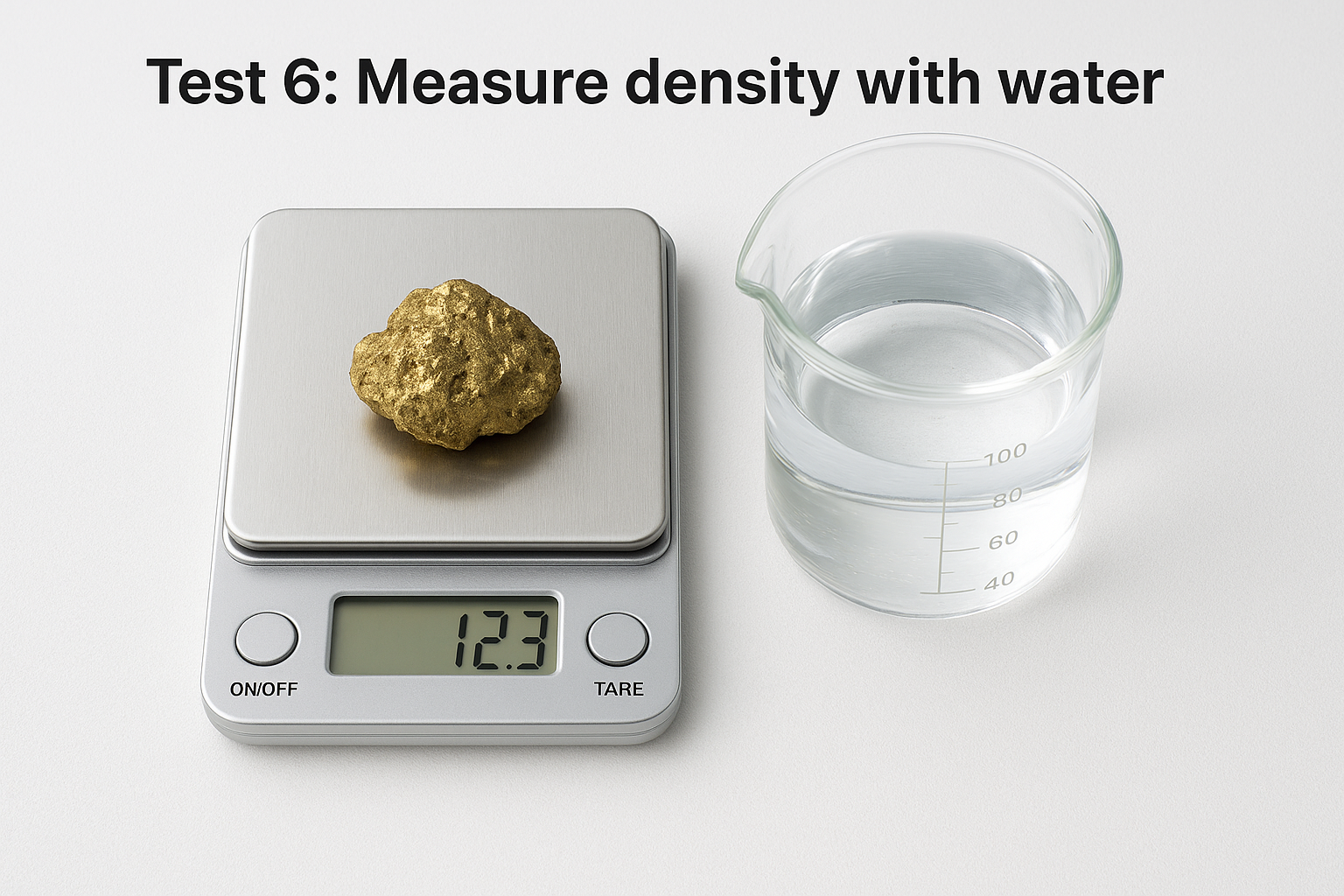
Weigh your specimen on the kitchen scale and record the weight in grams. Fill your container with water and note the starting level. Submerge the specimen completely and measure how much the water level rises. Divide the specimen’s weight by the volume of water displaced. Gold has a density of 19.3 grams per cubic centimeter, while pyrite measures only 5.0. If your calculation shows density above 15, you likely have gold.
Test 7: Test malleability carefully
Place your specimen on a hard surface and apply firm pressure with a hammer or heavy object in one controlled strike. Gold bends, flattens, or dents because it’s malleable and ductile. Pyrite shatters, cracks, or crumbles into pieces because it’s brittle. This destructive test definitively shows you how to tell pyrite from gold through physical behavior under stress.
Malleability testing destroys pyrite specimens but only dents gold, making it the most conclusive physical test available.
What else looks like gold and common mistakes
Pyrite isn’t the only mineral that confuses collectors and prospectors. Several other metallic substances create similar visual effects under certain conditions. Understanding these lookalikes helps you avoid false positives when testing specimens. Equally important are the testing mistakes that lead people to misidentify materials they’ve correctly narrowed down to gold or pyrite.
Other minerals that mimic gold
Chalcopyrite produces a brassy yellow color almost identical to pyrite but tarnishes quickly to iridescent purple, green, or blue. Mica flakes catch light and create golden sparkles in rocks, though they appear transparent rather than metallic under close inspection. Brass and bronze objects (especially antique ones) fool people regularly because their surface oxidation creates color variations similar to natural specimens.
Testing multiple physical properties rather than relying on color alone prevents misidentification of lookalike minerals.
Mistakes people make when testing
The most common error involves testing plated or filled jewelry and assuming the surface material represents the entire piece. People also apply insufficient pressure during scratch tests, failing to break through surface coatings. Another mistake: performing only one or two tests instead of using multiple methods to confirm results. When learning how to tell pyrite from gold, cross-verification eliminates doubt and produces accurate identification.
Quick recap and next step
You now have seven practical methods to distinguish between real gold and pyrite without sending anything to a lab. The color, streak, hardness, density, and malleability tests give you concrete answers backed by physical properties that never change. When you combine visual inspection with hands-on testing, you eliminate guesswork and identify your specimen with confidence. Learning how to tell pyrite from gold becomes straightforward once you understand that gold stays soft, dense, and yellow through every test, while pyrite breaks, scratches ceramic tiles dark, and resists pressure.
Whether your testing revealed genuine gold or authentic pyrite, both materials hold distinct value in different contexts. Pyrite’s architectural presence and metallic luster make it exceptional for high-end décor in executive spaces across the Emirates. If you discovered you’re holding pyrite and want to explore how this mineral transforms luxury interiors, browse the handcrafted pyrite collections at Natural Pyrite UAE. Each piece celebrates the raw beauty of this natural mineral without pretending to be something else.