Pyrite catches light like few other minerals can. That metallic flash, often mistaken for gold, comes from a specific combination of chemical composition and crystalline structure that makes this iron sulfide truly distinctive. Understanding pyrite physical properties gives you the knowledge to identify authentic specimens, appreciate their geological significance, and make informed decisions when selecting pieces for your collection or space.
At Natural Pyrite UAE, we source and craft 100% natural pyrite into statement pieces for discerning collectors and professionals across the Emirates. Our work depends on intimate knowledge of what makes genuine pyrite behave the way it does, its hardness, its streak, its characteristic luster. These aren’t just academic details; they’re the criteria that separate authentic high-luster specimens from synthetic imitations flooding the market.
This guide breaks down the essential physical characteristics of pyrite: from its cubic crystal system to its Mohs hardness rating, from the greenish-black streak it leaves on unglazed porcelain to the brassy yellow color that earned it the nickname “fool’s gold.” Whether you’re verifying authenticity or simply deepening your understanding of this remarkable mineral, the technical specifications ahead will serve as your definitive reference.
Why pyrite properties matter
Understanding the physical characteristics of pyrite goes beyond academic curiosity. Your ability to identify authentic specimens protects you from purchasing synthetic alternatives or misidentified minerals that flood the market. When you invest in a handcrafted pyrite piece for your Dubai office or Abu Dhabi residence, the technical specifications confirm what you’re actually acquiring. These measurable properties (hardness, streak, crystal form) serve as your verification toolkit, especially in a region where luxury mineral specimens command premium prices.
The knowledge translates directly into practical decisions. Pyrite’s hardness rating determines how you should handle and display your pieces, while its chemical composition explains why certain environmental conditions cause tarnishing. At Natural Pyrite UAE, we’ve seen collectors make costly mistakes because they couldn’t distinguish between genuine pyrite and cheaper alternatives like marcasite or chalcopyrite. The difference isn’t just aesthetic; it affects longevity, stability, and the integrity of your collection.
Authentication in a market of imitations
Synthetic pyrite floods the Emirates market, often marketed with misleading terms like “enhanced” or “treated.” You need concrete criteria to separate natural specimens from laboratory-created alternatives. The greenish-black streak test gives you immediate verification, since synthetic materials rarely replicate this exact color. When you examine a specimen’s crystal form, genuine pyrite shows distinctive cubic or pyritohedral structures that artificial versions struggle to reproduce consistently.
Your investment deserves this scrutiny. High-end architectural pieces and jewelry crafted from authentic pyrite maintain their value precisely because their physical properties remain stable over time. Synthetic alternatives may look similar initially, but they lack the geological authenticity that defines premium mineral specimens.
Knowing how to test for genuine pyrite protects both your investment and the aesthetic integrity of your space.
Quality assessment for collectors and designers
Not all natural pyrite exhibits the same level of quality. The luster intensity, crystal definition, and surface characteristics vary significantly between specimens. Your understanding of pyrite physical properties enables you to evaluate whether a piece meets the standards expected in luxury interiors. A high-quality specimen displays sharp crystal faces, brilliant metallic luster, and minimal oxidation or surface degradation.
Interior designers working on executive suites in DIFC or luxury villas in Palm Jumeirah rely on these specifications to select pieces that complement architectural vision. The hardness rating (6 to 6.5 on the Mohs scale) indicates durability for various applications, from desktop displays to mounted wall art. This technical knowledge prevents mismatches between your space’s requirements and the mineral’s capabilities.
Practical considerations for long-term care
Pyrite’s chemical nature (iron sulfide) makes it reactive under certain conditions. You need to understand which environmental factors accelerate deterioration and which preservation methods maintain the specimen’s appearance. Humidity levels in coastal areas like Dubai Marina affect pyrite differently than the drier climate in inland emirates. This isn’t theoretical; it determines your display location and maintenance routine.
The physical properties also dictate cleaning methods. Pyrite’s hardness allows gentle brushing, but its chemical sensitivity means you should avoid certain cleaning solutions. Your knowledge of these characteristics extends the lifespan of your pieces and preserves their visual impact.
Pyrite physical properties at a glance
The fundamental characteristics of pyrite create a distinct profile that sets this iron sulfide apart from every other mineral you might encounter. When you examine authentic pyrite, you’re looking at a material with specific, measurable attributes that remain consistent across specimens worldwide. These properties don’t just help with identification; they explain why pyrite behaves the way it does in different environments and applications.
Chemical composition and crystal system
Pyrite consists of iron and sulfur in a precise 1:2 ratio, giving it the chemical formula FeS₂. This combination produces a compound where each iron atom bonds with six sulfur atoms in an octahedral arrangement, creating the mineral’s distinctive properties. The crystal system follows an isometric (cubic) pattern, which explains why you often see pyrite forming perfect cubes or pyritohedrons (twelve-sided shapes with pentagonal faces).
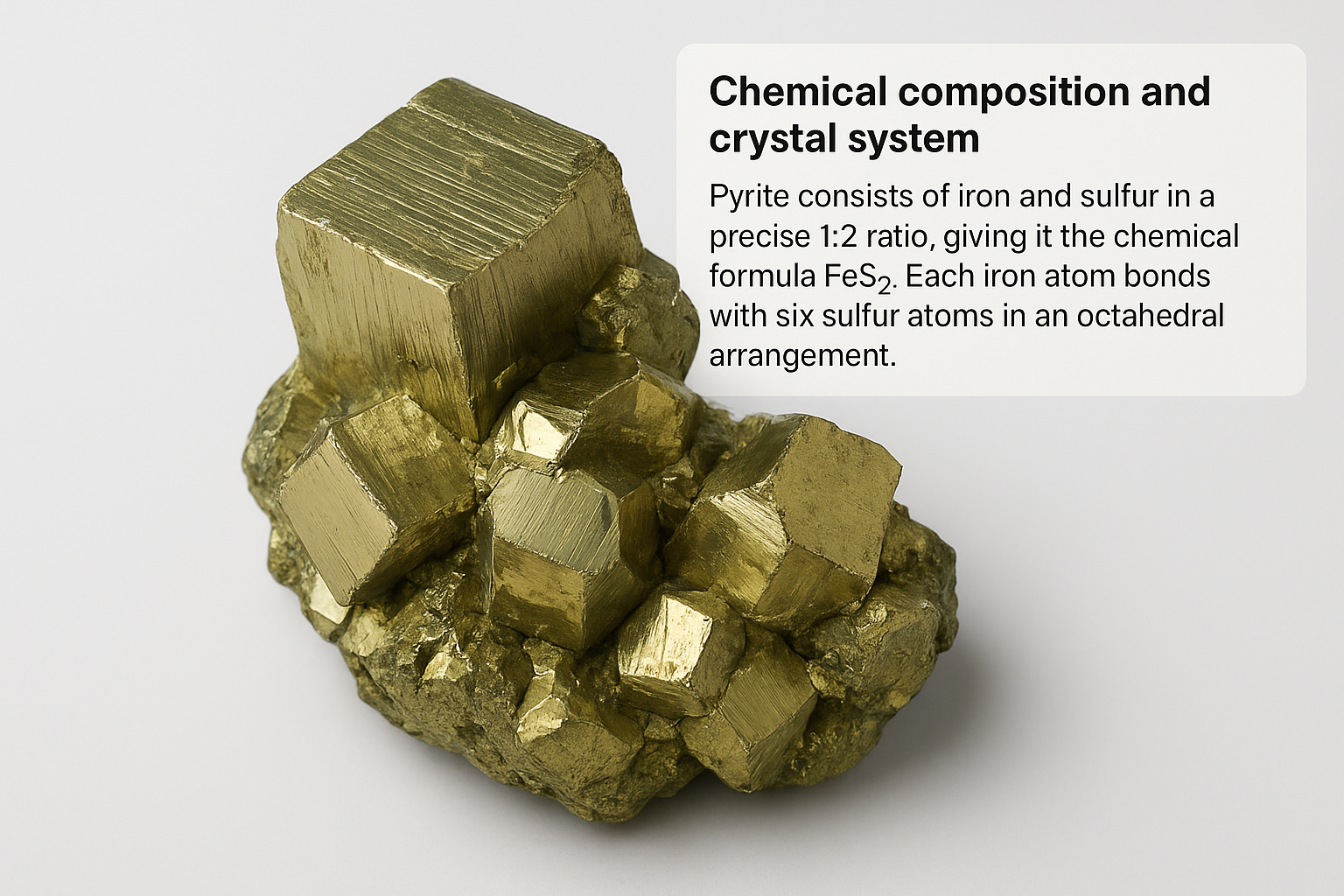
Your specimens may display striated crystal faces, a characteristic feature caused by oscillatory growth during formation. These striations run perpendicular to each other on adjacent cube faces, creating a pattern you can verify with close inspection.
Hardness and density measurements
Pyrite registers between 6 and 6.5 on the Mohs hardness scale, placing it firmly in the middle range. You can scratch glass with pyrite, but quartz will scratch pyrite. This hardness makes it durable enough for jewelry and decorative applications while still allowing artisans to work with it during crafting processes.
The specific gravity ranges from 4.95 to 5.10, meaning pyrite weighs nearly five times more than an equal volume of water. When you hold a genuine pyrite specimen, this density becomes immediately apparent in how substantial the piece feels relative to its size.
The combination of moderate hardness and high density gives pyrite its characteristic heft and durability.
Color and optical characteristics
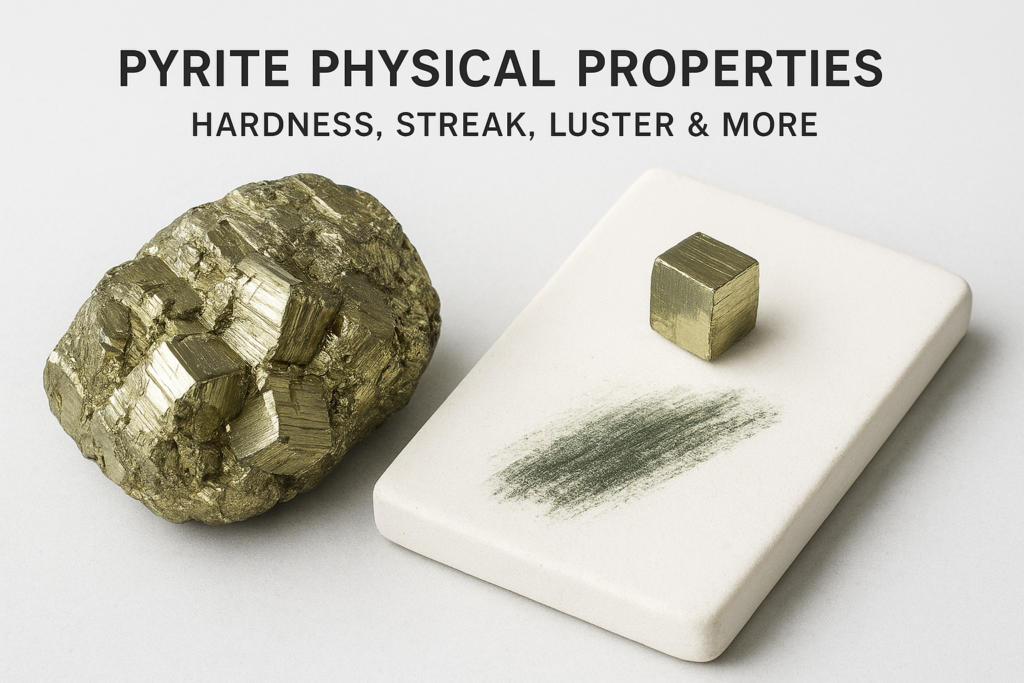
Pyrite displays a distinctive brassy yellow color with pale to normal yellow variations. The metallic luster creates that brilliant reflective quality you notice immediately, though the exact shade depends on crystal orientation and surface condition. When you streak pyrite across unglazed porcelain, it leaves a greenish-black to brownish-black mark, distinguishing it from gold (which leaves a golden yellow streak) and other similar minerals.
How to identify pyrite with simple tests
You don’t need laboratory equipment to verify pyrite authenticity. Several straightforward tests give you reliable confirmation using materials you likely have at home or can easily acquire in the Emirates. These methods reveal pyrite physical properties through direct observation and simple comparison, protecting you from purchasing misidentified minerals or synthetic alternatives that proliferate in luxury markets.
The streak test
Your most reliable identification method involves dragging the specimen across an unglazed porcelain tile. Pyrite leaves a greenish-black to brownish-black streak regardless of the specimen’s surface color or luster. You can find unglazed porcelain tiles at construction suppliers throughout Dubai and Abu Dhabi, or you can use the unglazed back of a bathroom tile.
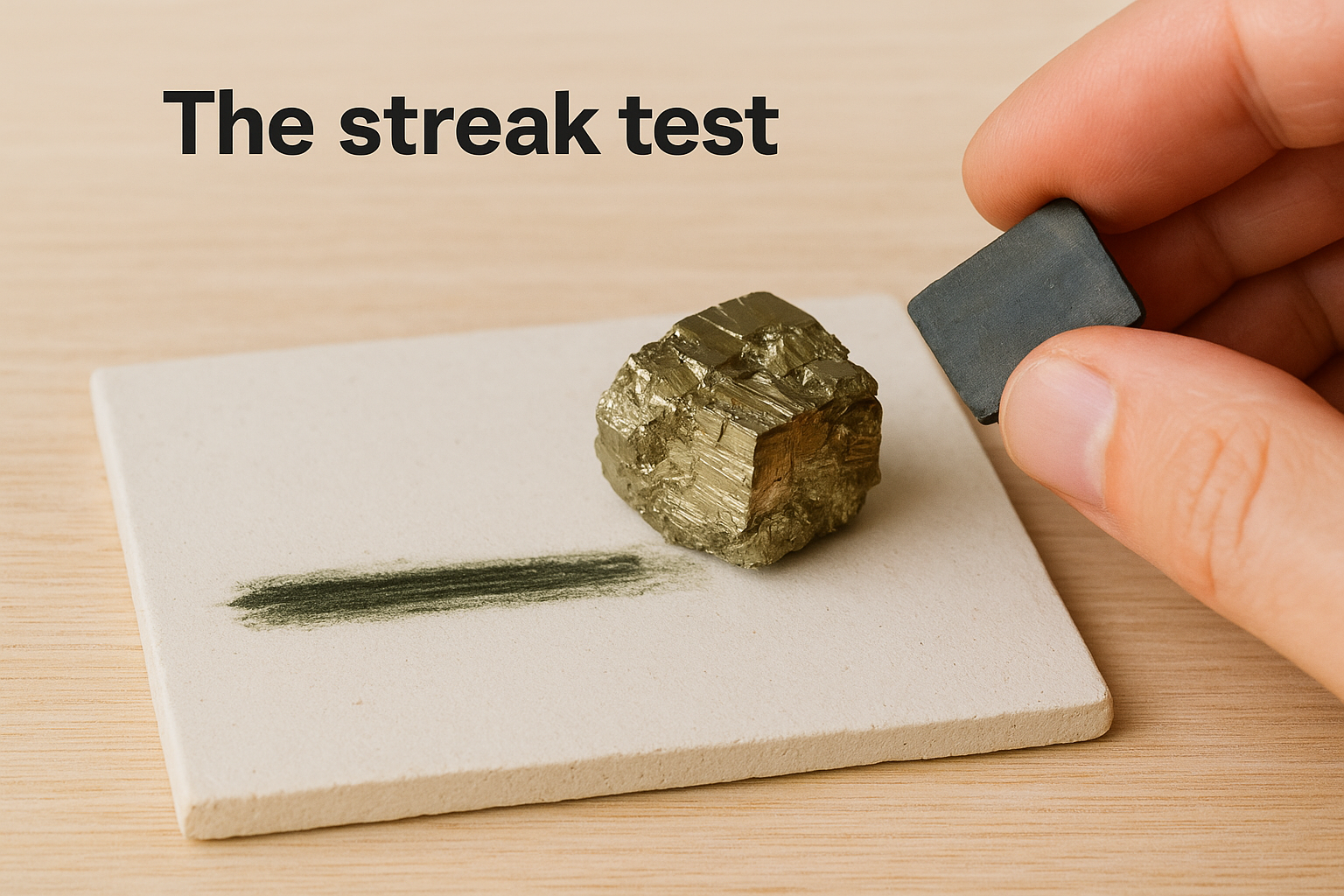
Gold produces a golden yellow streak, while marcasite (a common pyrite lookalike) creates a grayish-black mark. This single test eliminates most confusion because the streak color comes from the mineral’s true composition, not surface characteristics that might mislead visual inspection alone.
The streak test reveals what a mineral actually consists of, cutting through surface appearances that often deceive the eye.
Hardness testing with common objects
Pyrite scratches glass but yields to quartz. You can verify this by attempting to scratch a glass surface (use an inconspicuous area). Genuine pyrite makes a distinct mark on glass, confirming its Mohs hardness of 6 to 6.5. Then test whether a steel knife blade scratches your specimen. Steel typically measures around 5.5 on the Mohs scale, so pyrite should resist scratching from a knife.
Visual and weight assessment
Hold the specimen in your hand and notice its substantial weight. Pyrite’s specific gravity of approximately 5 creates a noticeably heavy feel relative to size. Examine the crystal faces under good lighting for the characteristic brassy yellow color and metallic luster. Authentic specimens often display cubic or pyritohedral shapes with striated faces, though not all natural pyrite forms perfect crystals.
How pyrite differs from gold and common lookalikes
The nickname “fool’s gold” exists because pyrite’s appearance deceives casual observers who mistake its brassy yellow color for actual gold. You need concrete differentiation criteria because the visual similarity costs collectors and buyers significant money when they purchase misidentified specimens. Beyond gold, several other minerals share pyrite’s metallic luster and yellowish tones, creating additional confusion in the marketplace. Understanding these distinctions protects your investment and ensures you acquire authentic pieces.
Pyrite versus gold
Gold’s malleability separates it immediately from pyrite’s brittle structure. You can bend or dent gold with a hammer, while pyrite shatters or crumbles under similar force. The streak test provides instant verification: gold leaves a golden yellow mark on unglazed porcelain, while pyrite produces that characteristic greenish-black streak mentioned earlier in this guide.
Weight differences become apparent when you compare equal volumes. Gold’s specific gravity reaches 19.3, making it nearly four times heavier than pyrite’s 5.0 measurement. Your hand instantly recognizes this density variation when holding specimens side by side. Gold also maintains a richer, more saturated yellow color compared to pyrite’s paler brassy tone.
Pyrite’s brittleness and greenish-black streak eliminate any genuine confusion with gold once you perform basic physical tests.
Chalcopyrite and marcasite confusion
Chalcopyrite displays a deeper golden color with a greenish tint that distinguishes it from pyrite’s brassy yellow. You’ll notice chalcopyrite scratches more easily, registering only 3.5 to 4 on the Mohs scale compared to pyrite’s 6 to 6.5. The crystal structure differs fundamentally: chalcopyrite forms tetragonal crystals while pyrite follows the cubic system described in pyrite physical properties.
Marcasite shares pyrite’s chemical formula (FeS₂) but crystallizes in an orthorhombic system rather than cubic. Marcasite appears paler and more silvery, lacks pyrite’s characteristic striations, and degrades faster when exposed to moisture. Your specimens from Natural Pyrite UAE undergo verification to ensure you receive authentic pyrite, not these common substitutes that deteriorate quickly in the Emirates’ coastal humidity.
Pyrite color, tarnish, and care considerations
Your pyrite specimen’s appearance changes over time based on environmental exposure and handling practices. The brassy yellow color that defines fresh pyrite can shift toward darker, duller tones when oxidation processes interact with the iron sulfide surface. Understanding these natural transformations and implementing proper care protocols preserves the aesthetic qualities that make pyrite valuable for luxury applications in executive spaces and personal collections.
Natural color variations in pyrite
Freshly broken pyrite surfaces display pale to normal yellow with that characteristic metallic brassy tone. You’ll notice variation even among authentic specimens based on formation conditions and trace element inclusion. Some pieces lean toward lighter, almost silvery yellows, while others show deeper golden hues. These differences don’t indicate quality issues; they reflect the diverse geological environments where pyrite crystallizes.
Crystal face orientation affects how light reflects off your specimen. The same piece can appear different under various lighting conditions in your Dubai office or Abu Dhabi residence, shifting between bright brassy yellow and deeper bronze tones as viewing angles change.
Tarnish formation and environmental factors
Oxidation creates darker surface coatings that obscure pyrite’s natural luster. When moisture and oxygen interact with iron sulfide, the mineral develops brown, black, or iridescent surface films. The coastal humidity in areas like Dubai Marina accelerates this process compared to drier inland locations. You’ll see tarnishing happen faster on specimens with greater surface area exposure.
Controlling humidity and limiting air exposure significantly slows the oxidation that dulls pyrite’s metallic brilliance.
Temperature fluctuations compound the problem by creating condensation on cool surfaces. Your climate-controlled interiors help, but specimens near windows or exterior walls face greater risk.
Preservation and maintenance practices
Store pyrite in low-humidity environments when possible, ideally below 50% relative humidity. You can achieve this with sealed display cases containing silica gel packets that absorb excess moisture. For pieces on open display, regular dusting with a soft, dry brush removes particles that trap moisture against the surface.
Avoid chemical cleaners entirely because pyrite physical properties make the mineral reactive to most solutions. Water alone risks accelerating oxidation, so keep cleaning mechanical rather than chemical. Your Natural Pyrite UAE pieces maintain their appearance best when you minimize handling and environmental exposure from the start.
Key takeaways
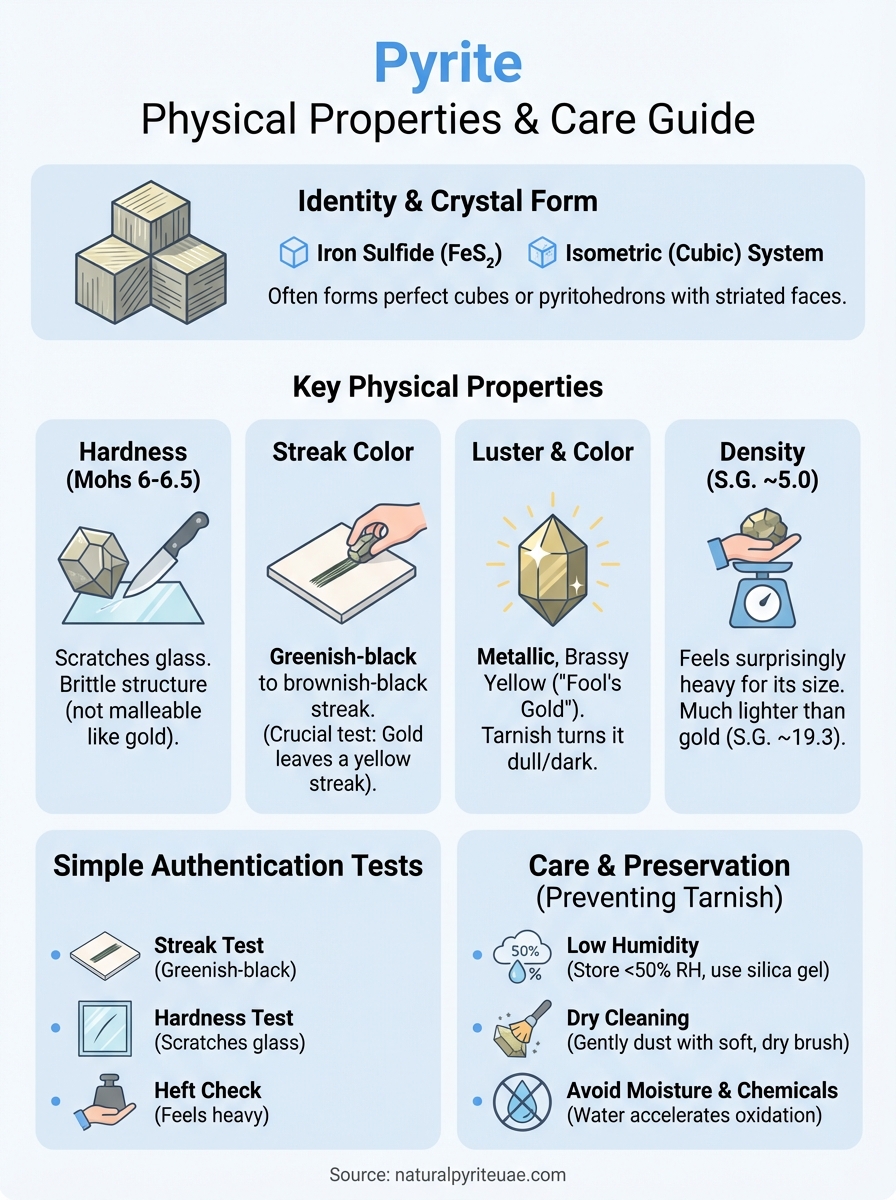
Understanding pyrite physical properties gives you the confidence to verify authenticity, assess quality, and preserve your specimens for years. The greenish-black streak test, hardness rating of 6 to 6.5, and specific gravity around 5.0 provide concrete verification criteria that separate genuine pyrite from gold, marcasite, and synthetic alternatives. You can perform these tests with simple household items, protecting your investment without laboratory equipment.
Your environmental conditions directly affect how pyrite maintains its brassy yellow luster. Controlling humidity below 50%, storing pieces away from moisture sources, and avoiding chemical cleaners preserve the metallic brilliance that makes pyrite valuable for luxury interiors. The technical specifications covered here translate into practical care routines that extend specimen lifespan.
Natural Pyrite UAE sources and crafts authentic specimens for collectors and professionals across the Emirates. Browse our handcrafted pyrite collection to find pieces verified through the physical properties outlined in this guide, delivered throughout Dubai and Abu Dhabi.